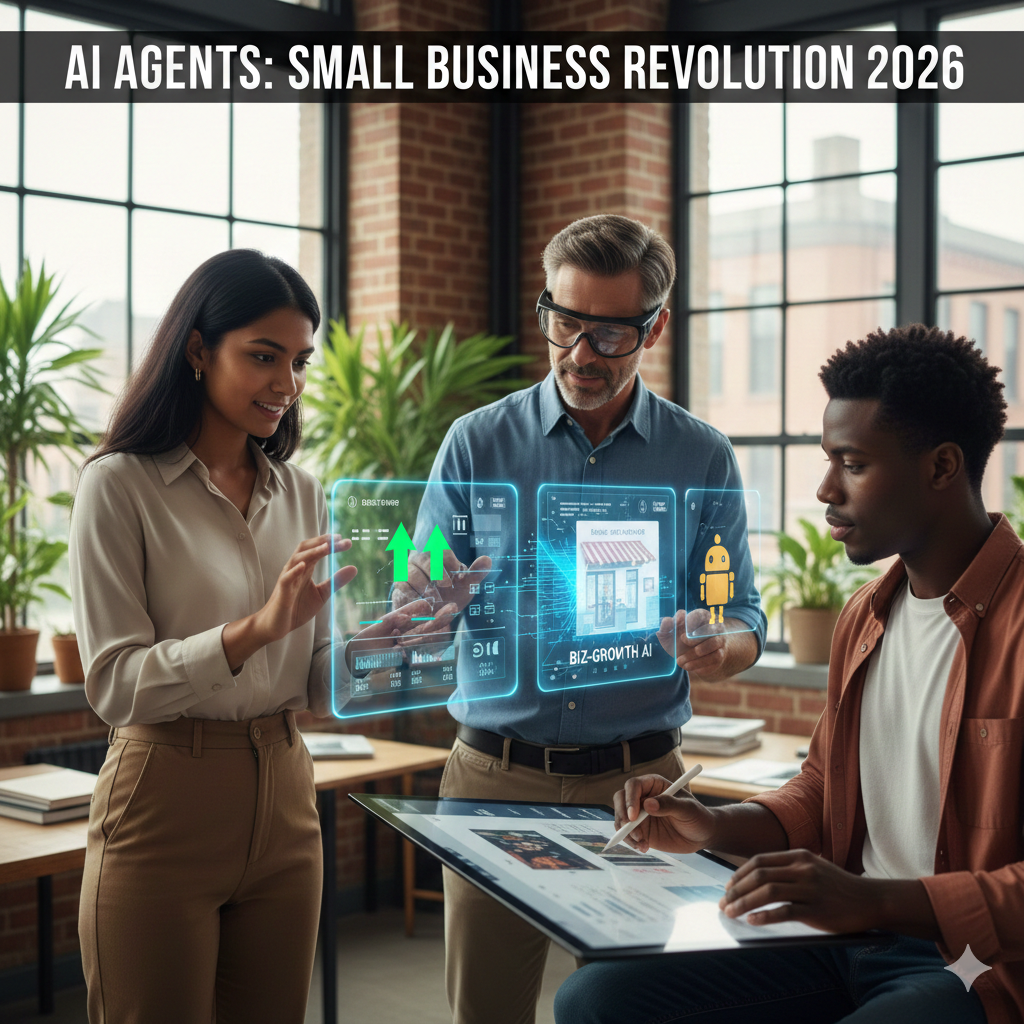

Starting in 2026, using Artificial Intelligence (AI) is now seen as an integral part of achieving a business strategy. This applies mostly to Small-to-Medium Enterprises (SME) with fewer resources than larger businesses yet are looking to use technology to compete with, grow and innovate their business. The most significant advancement in the development of AI has been the creation of AI Agents – autonomous systems that can act, learn and make decisions with little or no direction from people.
AI Agents vs. Traditional Software programs
AI Agents are not like traditional software programs which require constant direction and manual input; they can perform complex workflows, learn from new data, and adjust their performance over time. For small business owners who typically have smaller teams and tight budgets, the change from being a “good idea” to becoming “essential to achieving the business’ strategic objectives” is huge.
The objective of this blog post is to provide an understanding of how AI Agents will change the way small businesses operate in 2026. This blog post will examine the characteristics & definition(s), usage, costs, people’s roles and challenges associated with implementing AI Agents into a small business operation.
1.AI Agents defined
at a high level is an autonomous program that is capable of perceiving their environment, making decisions, and taking action to achieve results with little input from a human. AI Agents range from simple programs used to automate tasks to advanced AI programs that can learn, adapt, and work with a group of humans.
Unlike traditional automation (i.e. rule-based), AI Agents are dynamic. AI Agents can learn over time through the use of machine learning, natural language understanding, and sometimes even reinforcement learning. This means AI Agents do much more than just take instructions and execute them. AI Agents can also continually optimize their behaviour as they learn from experience.
As small businesses continue to use AI Agents, the main reason they are interested in AI Agents is that they allow small businesses to expand their capacity without adding new employees. The following are the main reasons why AI Agents are important for small businesses:
Increase in scalability without increasing cost: By using AI Agents, a small business can have one or more employees working on creative, strategic, and customer engagement functions while having at least one AI Agent handling diverse repetitive and complex activities. This gives small businesses leverage to create a greater amount of output with the same or even fewer employees.
Increase in speed and efficiency: Proposals that took hours or days to draft, customer data that took hours or days to analyze, and customer inquiries that took hours or days to respond to now take minutes or less to complete with the use of AI Agents.
Analysis of data through use of Artificial Intelligence (AI) agents that can gather much larger amounts of both structured and non-structured data, find the trends and patterns that humans may otherwise lose out on noticing, and create recommendations that can be completed in a timely manner. This gives small businesses who do not have their own data teams a huge advantage over their competitors.
Operating at a Constant Level of Work: People tend to get tired and make mistakes so that creates inconsistencies of service and performance for customers whereas AI will provide consistent performance and availability 24/7.

2.As of 2026, companies who are currently utilizing AI agents are not just optimizing their operations; they are changing how they will do business in the future.
Real World Use of AI Agents to Help Small Companies
AI agents have moved past pilot projects by early adopters, and the technology is now embedded in the core functions of businesses of all sizes across all types of industries. Following are real world applications that are benefiting small businesses the most.
Customer Service and Support
Historically, small businesses have struggled to provide continual, quality customer service, due largely to their staffing limitations. AI conversational agents currently function as the primary first point of contact for customer service.
24/7 Customer Service Agents: AI gives small companies the opportunity to provide a quality customer service experience that includes, answering frequently asked questions, resolving simple issues, and routing more complicated calls to the appropriate person if needed.
Omni Channel Customer Service: AI can interact with customers through multiple channels (website, social media, email, text, etc.) using only one system to manage and keep track of interactions, and provide relevant context for the customer’s interaction.
Based on the above stated points, small businesses have the potential for higher levels of customer satisfaction and quicker response times without increasing headcount in their customer service departments.
Sales And Lead Qualification
The use of Artificial Intelligence (AI) is enabling certain functions that traditionally required dozens of skilled human salespeople. Some key functions include:
- Automated Lead Scoring — AI will analyze incoming leads/contacts to determine if they are engaging with the sales process and score them based on their likelihood of converting into a sale.
- Personalized Outreach — Rather than using generic ‘template’ emails to reach out to leads, AI systems can develop tailored email messages based on each lead’s specific preferences.
A number of small to medium-sized businesses are now using the AI qualification process for all their sales prospects, making it possible for the sales team to focus only on those leads that have the greatest potential.
Marketing And Content Creation
With the help of AI agents, marketing departments (including smaller ones) are able to do more complex strategic tasks related to creating content, such as:
- Social Media Management — Agents will schedule the posting of content on social media platforms to maximize the visibility of the content as well as recommend which topics are trending to drive more traffic to their website.
- Search Engine Optimization (SEO) And Blog Generation — Agents will write and edit SEO-optimized blog posts for businesses, based on each specific word strategy and the performance data of each blog post.
- Audience Segmentation — Agents will analyze customer behavior and separate customers into specific audience segments so that the business may target them with specific marketing campaigns.
The end result is that these companies have been able to automate and completely eliminate an enormous amount of manual labor off their marketing efforts, resulting in more successful marketing overall.
Accounting, Finance, And Bookkeeping
Many small business owners can be required to have multiple functions, often while being responsible for tracking financial activities. As a result, AI technology has been developed so as to automate many different accounting functions including:
- Automating Expense Categorization — Agents can automatically interpret receipts and/ or transactions, thus eliminating the need for manual bookkeeping.
- Cash Flow Predictions — AI-based systems will analyze historical data related to payment trends and expenses to generate a prediction of future cash flow.
Sales And Lead Qualification
The use of Artificial Intelligence (AI) is enabling certain functions that traditionally required dozens of skilled human salespeople. Some key functions include:
- Automated Lead Scoring — AI will analyze incoming leads/contacts to determine if they are engaging with the sales process and score them based on their likelihood of converting into a sale.
- Personalized Outreach — Rather than using generic ‘template’ emails to reach out to leads, AI systems can develop tailored email messages based on each lead’s specific preferences.
A number of small to medium-sized businesses are now using the AI qualification process for all their sales prospects, making it possible for the sales team to focus only on those leads that have the greatest potential.
Marketing And Content Creation
With the help of AI agents, marketing departments (including smaller ones) are able to do more complex strategic tasks related to creating content, such as:
- Social Media Management — Agents will schedule the posting of content on social media platforms to maximize the visibility of the content as well as recommend which topics are trending to drive more traffic to their website.
- Search Engine Optimization (SEO) And Blog Generation — Agents will write and edit SEO-optimized blog posts for businesses, based on each specific word strategy and the performance data of each blog post.
- Audience Segmentation — Agents will analyze customer behavior and separate customers into specific audience segments so that the business may target them with specific marketing campaigns.
The end result is that these companies have been able to automate and completely eliminate an enormous amount of manual labor off their marketing efforts, resulting in more successful marketing overall.
Accounting, Finance, And Bookkeeping
Many small business owners can be required to have multiple functions, often while being responsible for tracking financial activities. As a result, AI technology has been developed so as to automate many different accounting functions including:
- Automating Expense Categorization — Agents can automatically interpret receipts and/ or transactions, thus eliminating the need for manual bookkeeping.
- Cash Flow Predictions — AI-based systems will analyze historical data related to payment trends and expenses to generate a prediction of future cash flow.
HR and Talent Management
HR tasks are time-consuming and sensitive. AI agents help by:
- Screening resumes and matching candidates to job requirements
- Scheduling interviews based on calendars
- Generating onboarding materials and tracking compliance
In 2026, even small teams can run efficient hiring processes without dedicated HR staff.
Operations and Supply Chain
Small retail and product businesses benefit too:
- Inventory prediction: Agents analyze sales data to forecast inventory needs, reducing stockouts and overstock.
- Order fulfillment management: AI systems can trigger restocking workflows and even route orders to optimal suppliers.
This operational intelligence is reducing waste and increasing customer fulfillment rates.
3. How Small Businesses Can Start with Low-Budget AI Tools
One of the major myths about AI adoption is that it’s expensive and only for enterprises. The reality in 2026 is very different. Today there are accessible, low-cost tools small businesses can adopt first — then scale over time.
Step 1: Identify Repetitive, High-Impact Tasks
Start by mapping daily tasks that are:
- Time-consuming
- Repetitive
- Rule-based
- Data-driven
Examples include email responses, scheduling, customer support, bookkeeping, and social media posting.
These are ideal candidates for AI agent automation.
Step2:Identify an entry-level AI tool
There are numerous AI-based entry-level systems available, with many priced under $50-100 per month, and generally based on subscriptions, that have an agent-like feature.
Here are some options:
-E-mail/scheduling assistants – These e-mail assistants will automate responses and coordinate calendars.
-Website chatbots – This type of chatbot is a great way to provide customer engagement on your website while avoiding the cost of a support team.
-Social posting generators – These can create social media posts and hashtags, also analyze how well they performed.
-A basic analytics agent – This type of AI agent will take data out of your sales platform and use it to recommend the next steps.
Because your team is small, you may wish to start with only 1-2 of these types of systems and continue to add more as your business grows.
Step3:Integrate your AI tools
AI tools can add value in your organization through the integration of the tools with any systems already established:
-Connect your chatbots with your CRM.
-Connect your scheduling agents with your calendars and booking software.
-Connect your analytics agents with your sales and marketing dashboards.
Integrating your systems can reduce fragmentation and improve reliability.
Step4:Measure your impact
Before implementing any new AI systems you should establish metrics for success. Some examples of metrics you might use are:
-How much time did you save each week?
-How many tasks did you automate?
-How many qualified leads did you receive?
-How satisfied were your customers?
These metrics can help you refine the system and prove its value.
Step5:Grow incrementally by using AI
As you become more comfortable using AI systems, you may find that you will want to expand the use of AI by adding more advanced AI systems such as:
-Text-to-speech systems
-Predictive analytics tools
-Knowledge-based recommender systems
As you add these types of systems and measure their success, you will continue to grow your AI systems.
4.Human Skills vs AI – Where Humans Will Always Have the Advantage
Although AI agents can be powerful business tools, they cannot replace the value of human beings. They serve as a complement to the human complement of value. Here are some examples of why humans continue to be relevant.
Creation and Strategy
While AI agents can optimize processes and execute tasks autonomously, they do not create a long-term strategy or vision in and of themselves. The following list illustrates some ways that humans influence this:
- Human beings are capable of big picture thinking.
- Human beings create brand narratives.
- Human beings can align a company’s culture and ethical framework.
- Human beings possess with emotional intelligence in marketing decision-making.
By providing this level of strategic oversight, humans ensure that AI supports the company’s goals instead of dictating them.
Relationship Development and Trust
AI helps facilitate interactions between businesses and customers (e.g., via support chatbots), however, the ability to build deep, meaningful relationships between individuals and organizations will always be reliant on the human ability to empathize and engage genuinely with other people.
For example, humans are best able to:
- Resolve customers’ complex complaints.
- Understand the often delicately felt emotions of a customer.
- Establishing trust in large value transactions.
In order for a human being to complete any of these tasks, the individual must be present in the situation.
Ethical Judgment
AI does not possess true morality, therefore human beings should guide how we use AI to ensure that it adheres to fairness, transparency, and establishes trust with customers.
For example, some of the things that humans should accomplish through ethical decisions when using AI include:
- Following due diligence when it comes to customer data privacy.
- Ensuring that AI does not have an inherent bias.
- Setting up rules that govern AI behavior.
There will never be any exception to the necessity for human ethical oversight.
Exceptional Problem Solving
Although AI can recognize patterns and optimize operations, it will never be able to solve a truly novel problem that requires human intuition, lateral thinking, or creative problem-solving.
The contributions of human beings include:
- Understanding the wider context of the world.
- Applying skills learned in one domain of knowledge to other domains.
- Creativity in finding solutions to problems.
These abilities represent a human resource that remains outside the direct control of any individual or organization.
In order for AI to succeed, it needs human leadership — this means motivating the team, sharing a common purpose, developing both the capabilities and the character of employees — all things which require the personal touch of an experienced leader.
In summary, AI will support the workflow, while humans will lead the people.
The following are predictions and potential pitfalls about AI Agents in Small Businesses.
- Democratization of AI Technology
- There will be more affordable and accessible AI-based tools. Expect to see plug-and-play style solutions designed so that non-technical business owners and managers won’t have difficulty implementing or using those tools.
- 2.Cooperation Between AI and People Within Work Environments
- By the year 2027, most small businesses will have “hybrid” work environments, meaning that AI agents will be managing daily operational work while humans will spend the majority of their time on high-level strategic issues.
3.Development of Specialized AI Agents for Various Industries
- We can expect to see an increase in will AI Agents developed specifically for niche markets and industries such as Retail, Health Care, Hospitality, Legal Services, etc. Each of these niche AIs will be designed with specific workflows and functions for that specific industry.
4.Development of AI Regulations and Governance
- All levels of government, along with appropriate industry associations, will begin developing rules and guidelines regarding the use of AI, data privacy, and accountability of autonomous systems.
Those small businesses that implement AI technology early will have a competitive advantage over their competitors; however, they will be required to also ensure compliance.
- Ethical AI as a Differentiator
More consumers will prefer businesses that have transparent practices surrounding the use of AI in how they handle data and use automation for decision-making purposes. Thus, Ethical AI will be one of the differentiators of businesses.
5.Pitfalls: Challenges Small Businesses Must Overcome
- Over-Automation
Many customers still desire face-to-face interaction with humans, so relying excessively on AI agents can create a sense of disconnection from the brand. There is a need to ensure there’s an appropriate balance between automation versus authentic contact with a human. - Data Privacy & Security Risks
Data is what fuels AI. If a company improperly manages customers’ private data, it can create compliance issues and/or result in potentially severe reputational damage.
Small businesses should put in place a comprehensive data governance program and sufficiently protect any sensitive information.
- Skill Gaps
The use of AI in the workplace requires at least some level of technical understanding. If teams have not had adequate training, they may underutilize or misapply the technologies.
Investing in education and change management will be critical.
- Ethics
If not closely monitored, AI can potentially make unintentional mistakes, create biases, or make decisions that could negatively affect customers or employees.
Establishing clear policies and continuing to perform audits are essential.
- Vendor Lock-In
There are multiple AI solutions that operate on proprietary platforms. Therefore, small businesses should evaluate the risks associated with vendor lock-in in regards to the potential for losing control of their data (data portability).
Conclusion
By 2026, AI agents will no longer just be in an experimental phase, but rather as powerful tools of business that drive growth, improve operational efficiencies, and create an equal opportunity for all small businesses. AI agents are helping reshape every aspect of how we operate, including customer service, marketing strategy, financial processes and operations processes.
AI does not replace us, but instead helps empower us. The companies that will be most successful will combine the speed, power of large amounts of data, and the efficiency of automated processes enabled through AI agents with the creativity, empathy and judgment of their human teams.
Small business owners who are interested in experimenting with, learning from and adapting to new technologies will find that the AI Revolution presents them an opportunity unlike any we have ever experienced in the past decade.